
AI Transformation Starts at Home: How We Rebuilt Our Own Language Services Business with AI
Most companies selling AI transformation (AX) can tell you what could happen in your business. We can tell you what already happened in ours.
Over the past year, XL8 has been transforming its subsidiary, AHT, a transcription and translation service provider for government agencies and law enforcement departments. It's a demanding business: clients depend on accurate transcripts and translations, and they rely on human professionals to stand behind every file delivered. One mistake in a law enforcement transcript isn't a typo. It can become a problem in a case.
That made AHT an ideal test of a hard question: can AI transform a service business whose entire value rests on precision and human accountability, without cutting corners on that value?
The answer was yes. The way we got there is what we now offer to other language service providers and media companies.
AI does the heavy lifting. Humans guarantee the result.
The obvious shortcut would have been to hand everything to the machine and call it efficiency. We didn't. AHT's clients pay for verified accuracy backed by human professionals, and that promise has to stay intact.
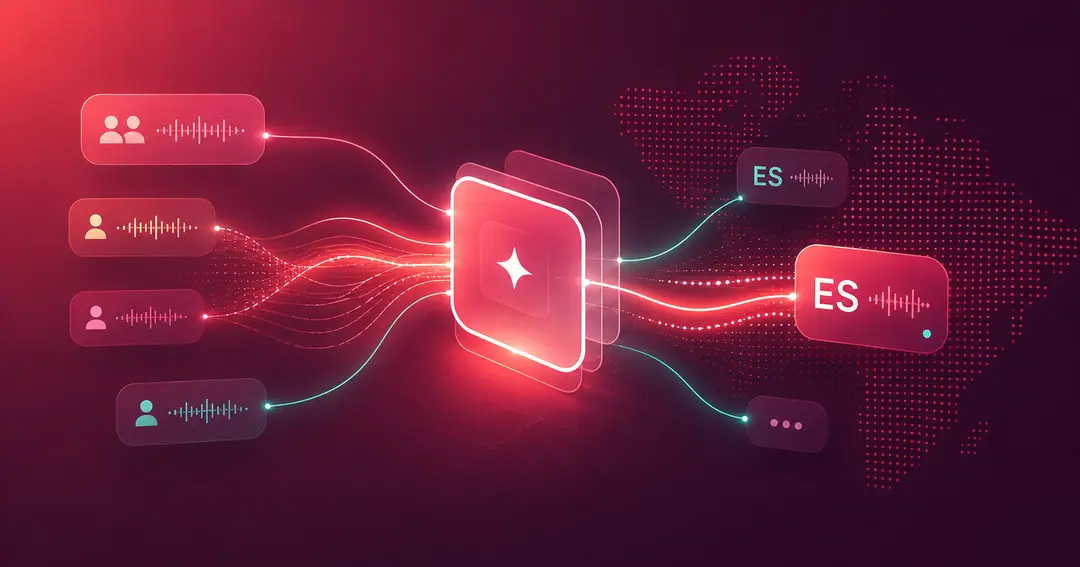
So we split the work by what each does best. AI now handles the time-consuming bulk of the job, producing transcripts and translations at scale. Human linguists step in where their judgment truly matters, reviewing and verifying the output at the critical points before it's signed off. And before any file goes out, an additional AI-powered quality check reviews the final result and flags anything that deserves a second look.
Linguists no longer spend hours on work a machine can do in minutes, and every delivery still carries a professional's guarantee. Accuracy didn't drop. It went up, because the people responsible for it now have the time and focus to get it right.
We automated everything around the core
The linguistic work was only half the story. The other half was the operational load surrounding it. Operations managers and project managers were each handling thousands of projects every month. Their days were filled with tasks like:
Ingesting and organizing incoming media assets
Tracking the progress of every project across every stage
Delivering the right files, in the right format, to the right client
Generating invoices and following up on accounts receivable
These tasks are repetitive, high-volume, and unforgiving of small errors. A file sent to the wrong agency or in the wrong format creates real damage. They're also exactly the kind of work AI handles well. Today these workflows run on AI, and they run faster and more accurately than they did when people were juggling them by hand.
AHT’s clients felt the difference. Files now arrive much faster, and the small human errors that used to slip through the cracks, such as invoicing mistakes, have disappeared entirely. Client satisfaction has gone up as a result.
People now spend their time where it matters
Automation didn't shrink the AHT team's role. It changed it. Instead of chasing files and status updates, the team now spends its time on the two things that actually define the business: working directly with clients and raising the quality of the final deliverables.
That's what good AX looks like to us. Not fewer people doing the same job, but the same people doing a better one.
Powered by MediaCAT, but not limited to it
At AHT, much of this work runs on MediaCAT, XL8's AI-powered media localization platform. MediaCAT brought proven building blocks to the transformation: media handling, AI quality checks, and workflow automation built for the realities of language and video work.
But AX shouldn't require you to switch platforms. Most service providers have already invested years in their tools, from translation management systems and project trackers to asset storage and billing software, and their teams know those tools inside out. Ripping them out to adopt something new is costly, disruptive, and often unnecessary.
So we don't ask you to. If your team already works in a set of tools, we can build AX directly into them. We connect to the systems you use today and automate the work inside your existing environment, so your team keeps working the way they're used to, only with far less manual effort. Where MediaCAT is the right fit, we'll use it. Where your current stack is the right fit, we'll build around it. The goal is the transformation, not the platform.
Your workflow isn't generic. Your AX shouldn't be either.
Here's what we learned most clearly: no two service providers work the same way. AHT has its own clients, delivery rules, file formats, approval steps, and billing practices. An off-the-shelf solution would have forced AHT to change how it works to fit the software. We did the opposite.
That's the approach we bring to other LSPs and media companies. We start by understanding your business in detail: your systems, your workflows, your client requirements, and the exceptions your team handles every day that no generic tool accounts for. Then we design and build AX that fits all of it, and we see it through from first analysis to full deployment.
We work end to end, whether that means building on MediaCAT, inside the tools you already use, or a mix of both. You don't have to stitch together vendors, consultants, and integrations yourself. And because we've already done this inside our own business, we know where the real friction lives in language and media operations, and where AI can remove it without putting quality at risk.
Let's talk about your operations
If your team spends more time managing projects than improving them, we'd like to hear about it. Whether you're a localization provider, a transcription service, a post-production house, or any business built around video and language, and no matter what tools you use today, XL8 can help you design an AX that fits the way you actually work.
[Contact us] to start your AX